Most are pocket change.
A few are calculated risks.
Condition is everything.
Standard copper-nickel composition defines the 1973 quarter issue.
This specific period is characterized by the absence of commemorative marks on the reverse side.
Each coin functions as a link between the 1965–1974 series and the Bicentennial anniversary release.
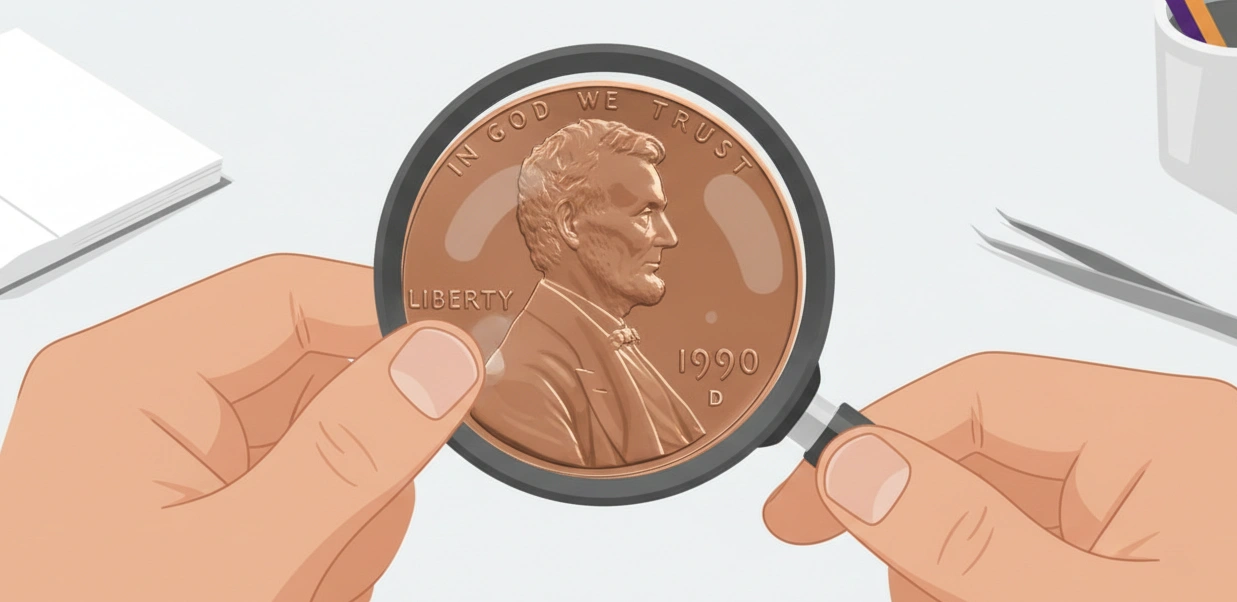
Numismatic 1990 penny value for the vast majority remains limited to face value due to mass production.
Minting in 1973 followed standards established by the Coinage Act of 1965.
Outer layers of the coin consist of an alloy featuring 75% copper and 25% nickel.
Pure copper forms the inner core.
Weight of the piece is exactly 5.67 grams.
Planchet diameter is fixed at 24.26 millimeters.
Edge thickness measures 1.75 millimeters.
Reeds on the edge of the coin number 119 units.
Characteristic | Parameter |
Total Weight | 5.67 g |
Thickness | 1.75 mm |
Diameter | 24.26 mm |
Material | Clad Copper |
Shape | Round |
Statistical Data by Mint Facility
Production cycles spanned three primary locations with varying output volumes.
Philadelphia Mint did not apply marks to the obverse of the coin.
Denver Mint identified its production with the letter D.
San Francisco Mint produced exclusively Proof-quality specimens with the letter S.
1973 Mintages by Department
Location | Mark | Mintage |
Philadelphia | None | 346,924,000 |
Denver | D | 232,977,400 |
San Francisco | S | 2,760,339 |
Total mintage reached 582,661,739 units.
Such supply volume precludes any shortage of common coins on the market.
Financial Risk: Analysis of MS67 and MS68 Condition
Purchasing a 1973 quarter without certification from grading services represents a high-risk action.
Price gap between MS65 and MS67 grades reaches 15,000%.
Main difficulty lies in locating specimens devoid of contact marks.
Transportation in bulk bags led to surface damage on the majority of coins.
Auction Records and Market Price
Issue Type | Grade | Realized Price | Sale Date |
1973-S Silver-Like | PR70 DCAM | $2,760 | 2007 |
1973-D Regular | MS68 | $1,438 | 2013 |
1973-P Regular | MS67+ | $1,140 | 2018 |
1973-D Regular | MS67 | $240 | 2021 |
Value for coins in MS63 grade averages $2.
Price for an MS65 specimen fluctuates around $15.
Annual value growth for top-tier MS67+ grades over the last 5 years stood at 3.8%.
Conversely, the value of common MS60 coins declines by 2% annually relative to purchasing power.
Survival Statistics of Rare Specimens
Grading companies PCGS and NGC track confirmed condition states.
Statistics reveal an extremely low survival percentage for perfect coins.
Low quality control standards in 1973 resulted in the scarcity of the MS68 grade.
PCGS Registry Data (2025)
Philadelphia in MS67 grade: 48 units
Denver in MS67 grade: 182 units
Denver in MS68 grade: 1 unit
San Francisco in PR70 grade: 89 units
Discovery of a new MS68 specimen would trigger a market price correction of 25–35% for the existing rarity.
Investment appeal of such assets is directly linked to their uniqueness within the registry.
Defects and Numismatic Errors
Market for 1973 error coins exists independently from the standard grade market.
Value of these objects does not depend on the purity of the coin's field.
Production mistakes are recorded by experts and maintain steady demand.
Confirmed Defect Types
Struck on wrong planchet. Using 10-cent planchets results in a weight reduction to 2.27 grams.
Double strike. Overlapping of two images with a shift in the striking axis.
Missing copper layer. Disruption of the cladding process exposes the copper core on one side.
Die crack. Raised lines on the coin formed due to the destruction of the press working surface.
A 1973-D quarter with an off-center error exceeding 40% is valued at $220–$280.
Coins with deep die cracks trade at prices between $45 and $70.

Impact of the Bicentennial Program on 1973 Issues
Preparation for the US 200th anniversary began three years prior to the event.
Mint planned to cease the standard design in favor of the commemorative one.
Legislative restrictions prevented the issuance of coins with a 1975 date.
Consequently, 1973-dated dies were used with increased workload.
Utilization of worn equipment negatively impacted the striking quality at the end of the year.
Surfaces of such coins possess a matte tint and indistinct relief details.
Market valuation for coins with signs of die wear is 20% lower compared to early strikes.
Grading as a Risk Mitigation Method
Investing in uncertified 1973 coins is equivalent to gambling.
Visual inspection without a microscope often hides microscopic scratches.
Grading by PCGS or NGC is a mandatory step for fixing a price above $100.
Weight verification allows for the filtering out of crude fakes and imitations of rare errors.
Allowable weight deviation for an uncirculated coin is 0.13 grams.
Evaluation Scale for 1973
MS60: Dull luster and presence of deep scratches on Washington's hair
MS63: Good luster with several noticeable hits on the reverse
MS65: High detail on the eagle's feathers and minimal field damage
MS67: Perfect appearance while maintaining full mint luster structure
Expense Structure for Investing
Acquiring a 1973 quarter requires accounting for associated costs.
Professional grading costs range from $25 to $60 per unit.
Logistics and insurance add another 10% to the cost basis.
Realizing a coin at auction entails a commission of 15–20% of the final price.
Growth of at least 40% in asset price is required to reach the break-even point.
For 1973 quarters, such growth is only possible through a grade increase upon re-evaluation.
Verification Resources
US Mint Archives
PCGS CoinFacts Price Guides
Heritage Auctions Sales Reports
Coin ID Scanner
NGC Census Database
Official Treasury Department Bulletins